

Many photographers, teachers, and small business owners need to stop others from misusing their PDF files. However, typical review articles often list dozens of tools without explaining real limitations such as batch sizes, offline capabilities, or how files are stored.
We narrowed it down to five solid options that balance simplicity, security, and cost.
The right choice depends on what you need. You might want fast processing for many files, zero uploads for sensitive documents, or easy branding across large batches. Each platform was reviewed for documented features, pricing transparency, how long they’ve been operating, and their focus on PDF protection.
Why PDF Watermarking Tools Are Used
At their core, PDF watermarking tools solve a common problem. They help users protect documents and build brand recognition without forcing them to learn complex design programs.
You’ll find them used by photographers marking sample images, real estate agents on property sheets, teachers sharing course packs, and small businesses securing proposals.
The main concerns are almost always the same — stopping unauthorized sharing and preventing brand dilution when files go out externally. Regular PDF editors tend to create friction because they miss batch features, need installation, or store files on external servers. That’s exactly where specialized watermarking platforms make a difference.
Broadly speaking, the tools fall into three categories: simple free web tools for light use, paid SaaS options for regular volume, and API solutions built for automation.
Top 5 PDF Watermark Tools
Not every PDF watermark tool works the same way. Some are built for teams. Others focus on speed, privacy, or low cost. Below are five solid options. Each has a different strength depending on what you need.
Watermarkly — Speed-Focused Batch Watermarking for High-Volume Users
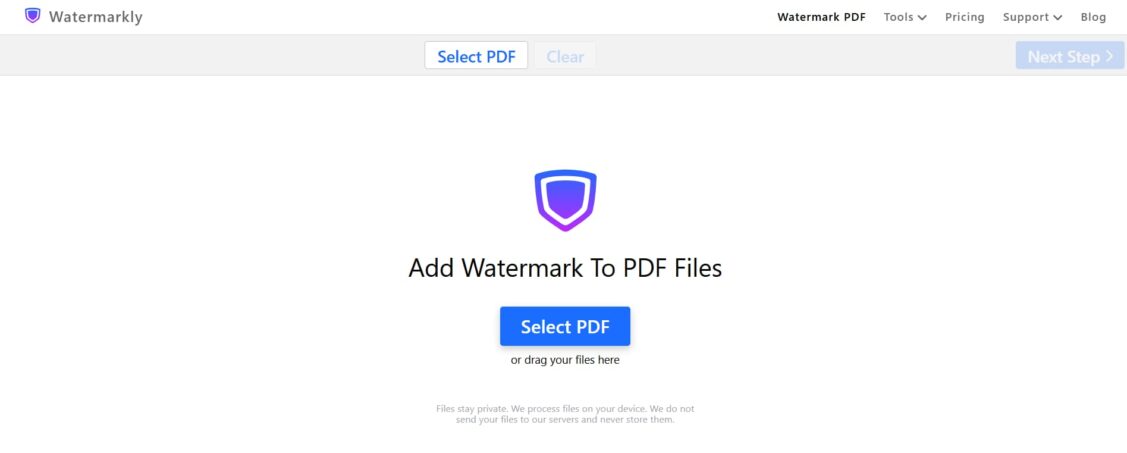
Watermarkly is an all-in-one online tool for watermarking images, videos, and PDFs. It also provides resizing, compression, and face-blurring options. This one works particularly well for users marking over 100 files weekly who need cross-format support. It delivers fast processing without cutting corners on customization.
It mainly appeals to photographers, content creators, small businesses, and educators. Strong user ratings — 4.9/5 on Trustpilot (2,500+ reviews) and 4.8/5 on the App Store — show it delivers consistent results.
Core capabilities:
| Feature | Detail |
| Batch watermarking | Process 100 files in <5 minutes |
| Formats supported | Images, videos, PDFs |
| Customization | Text + logo watermarks |
| Additional tools | Photo resizing, compression, cropping, and blurring |
You don’t need to sign up for basic use, and it supports 20 languages. Pricing is straightforward: $19.95 per year or a one-time $39.95 for lifetime access, both with a 30-day money-back guarantee. It also integrates smoothly with Google Drive, Google Photos, and Dropbox.
The interface is clean and beginner-friendly — simply upload, customize, and download. This makes batch jobs much less painful.
Weakness: The platform is geared more toward creators and visual branding workflows than advanced enterprise PDF management.
Smallpdf — Enterprise-Grade PDF Suite With Priority Support
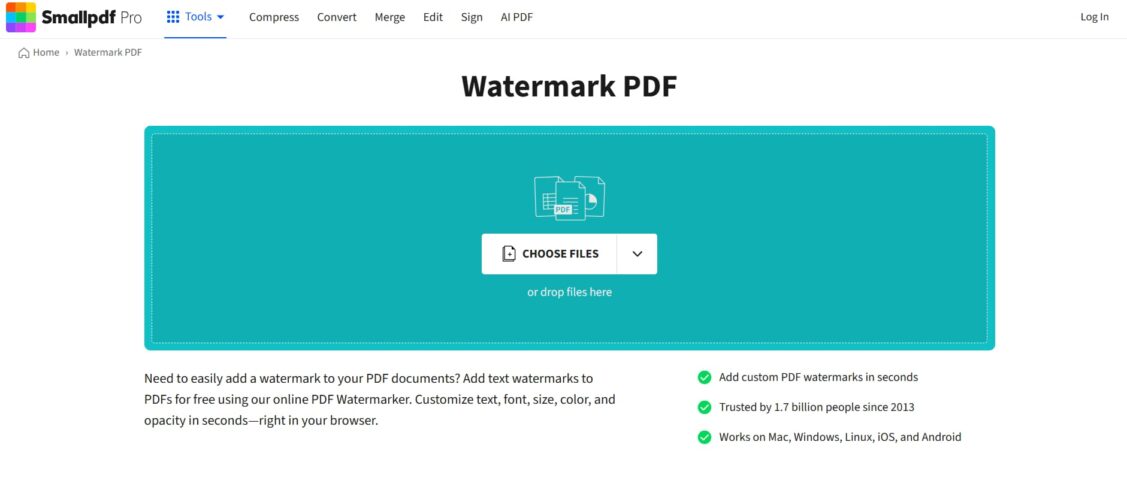
Smallpdf presents itself as the first and only PDF software that users will love, trusted by over a billion users worldwide. The platform bundles more than 30 tools, including merge, JPG to PDF, sign, edit, compress, PDF to Word, PDF to Excel, and PDF to PowerPoint, making it a full-service document hub rather than a single-purpose watermarking solution.
Teams needing watermarking as part of a broader document workflow — plus compliance tracking and priority support — find Smallpdf’s all-in-one platform worth the premium.
Pros:
- Full suite of PDF tools (merge, split, convert, compress, sign)
- Priority support and team billing options for Pro for Teams accounts
- Google Drive, Dropbox, and Google Workspace integrations
Cons:
- Pricing not publicly listed — requires sales contact for Pro/Teams tiers
- Overkill for users who only need watermarking (paying for unused features)
The platform positions for productivity-focused teams juggling multiple document operations daily. Free trial cancellable anytime, with automatic downgrade to free plan after 7 days.
Weakness: The platform bundles watermarking into a broader PDF suite, which may add unnecessary cost for users seeking a simple standalone watermarking tool.
iLovePDF — 100% Free Core Tools for Occasional Users
Budget-conscious users or those watermarking fewer than 10 PDFs monthly get full functionality at zero cost, with optional Premium for unlimited processing.
iLovePDF presents itself as an all-in-one PDF platform with free, easy-to-use features. It offers tools to merge, split, compress, convert, rotate, unlock, watermark, and edit PDFs without requiring account creation for basic use.
Pricing tiers:
- Free: Includes PDF Reader and access to all tools with limited processing
- Premium Monthly: €9/month with unlimited document processing across Web, Mobile, and Desktop
- Premium Yearly: €60/year with unlimited document processing across Web, Mobile, and Desktop
The platform positions itself as an all-in-one PDF toolkit with enterprise-grade security standards and GDPR compliance. Files are stored for a maximum of 2 hours before permanent deletion. Google Drive and Dropbox integrations allow direct cloud imports without local downloads.
The service also follows EU GDPR standards, which may appeal to users handling sensitive business documents or client files.
Weakness: Free tier limits batch size and processing frequency — power users hit caps quickly and must upgrade to Premium.
Visual PDF — Privacy-First Browser Tool With Zero Data Collection
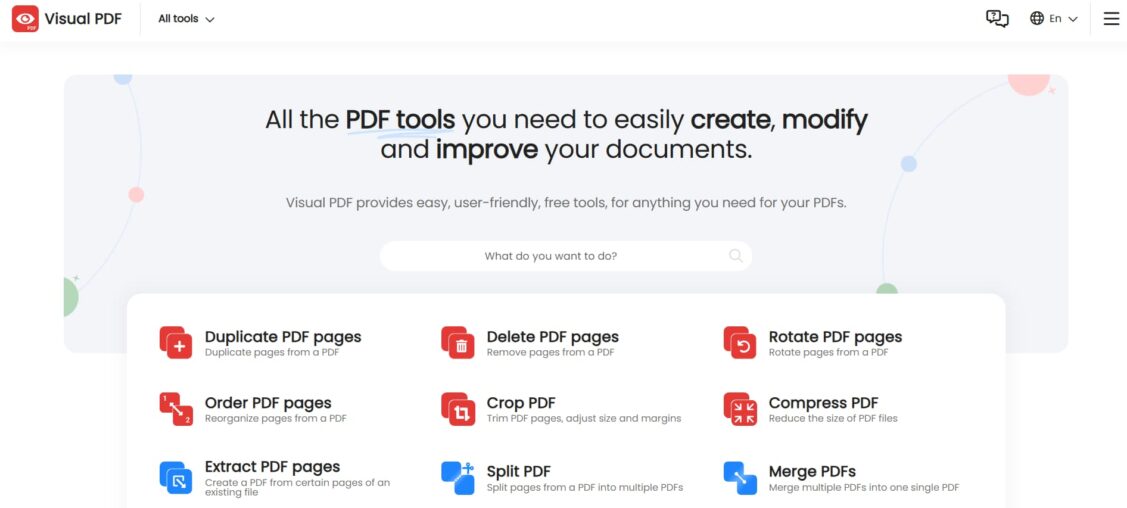
Compliance-sensitive teams in legal, healthcare, and finance often need strong privacy guarantees. Visual PDF meets that need with a fully browser-based tool that processes everything locally — no files are uploaded to any server.
The platform focuses on PDF editing, conversion, watermarking, and document organization, all while prioritizing privacy. It runs straight in your browser with zero installation required.
Here’s what stands out:
- Local processing — Files never leave your device
- Core tools — Merge, split, crop, convert, watermark, and protect PDFs
- REST API — Makes it easy to integrate into custom apps and automated workflows
Visual PDF brings together editing, compression, signing, watermarking, and password protection in one clean interface. It also supports multiple languages and offers API access for developers.
The free browser version removes any cost barrier for individuals. For companies, the REST API opens up enterprise possibilities like automated invoice watermarking or batch branding. That said, they don’t publish API pricing — expect custom quotes for commercial use.
Weakness: No documented batch processing limits or performance benchmarks — unclear whether it handles 100+ file batches as efficiently as desktop apps.
Sejda — Hybrid Online/Offline Access for Flexibility
Sejda is a straightforward PDF editor that gets the job done efficiently. The real advantage is flexibility. You can use it online through your browser, or offline with the desktop app. Choose whichever works best for you.
The platform includes more than 30 different PDF tools. Both the online and desktop versions are fully featured, but the desktop app has a clear advantage for privacy-conscious users — it keeps all your files stored locally and never uploads them to external servers.
Licensing options include:
- Web Week Pass: $5 for 7 days with access to Sejda Web
- Web Monthly: $7.50/month with recurring billing for Sejda Web access
- Desktop+Web Annual: $63/year with access to both Sejda Web and Sejda Desktop
Core features include PDF editing, PDF to Word conversion, merging, image conversion, page deletion, password protection, compression, and OCR processing. The desktop application handles files locally, which helps meet offline workflow and data residency requirements.
Weakness: Pricing structure more complex than competitors (three tiers, dual billing cycles) — buyers must calculate which combination fits their usage pattern.
How to Choose a PDF Watermark Tool
Consider these practical factors when comparing options:
- Processing approach: Browser tools offer instant access with no install. Desktop apps allow offline work and keep files local.
- Batch processing: Essential for high-volume users. Some tools manage 100 files in minutes, others force slow single-file handling.
- Company stability: Platforms operating for 10+ years tend to be more dependable.
- Privacy: Check if files stay on your device or get uploaded. Some services never collect data at all.
- Pricing clarity: Published prices make decisions easier than “contact sales” models.
- Extra features: Watermark-only tools versus full suites like iLovePDF that also merge, split, and compress files.
Conclusion
We compared these PDF watermark platforms based on pricing transparency, documented features, years in operation, and dedicated watermarking capabilities. General-purpose editors and services with unclear pricing structures were excluded.
Many creators and small businesses still struggle with the choice between risky unprotected sharing and time-consuming manual work. The five platforms here address that gap with automated options, including free tiers.
Try the free version first with your typical workload, test batch speed on 10–20 files, and confirm the privacy policy works for you before upgrading.